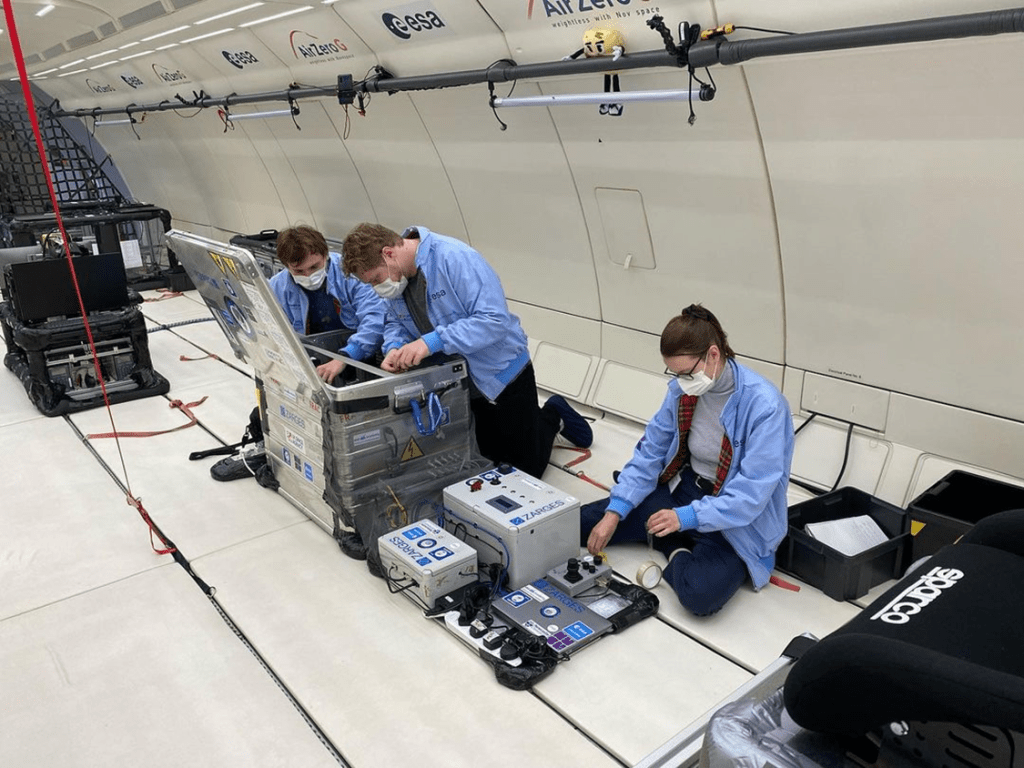
With planned missions to the Moon and Mars, understanding the impact of microgravity on biological organisms has never been more important. Parabolic flights offer short periods of simulated microgravity using modified commercial airliners. However, studying live cells on parabolic flights is a major challenge due to intense aircraft vibration and very short 15-20 second windows of weightlessness. To solve this, we developed FlightScope, a new microscopy and microfluidics platform designed to study dynamic cellular processes in real-time during these flights, recently published in npj Microgravity (pre-print also available).
We engineered FlightScope to be a vibration-resistant fluorescence microscope that could withstand the tough conditions on the plane. Its most unique feature is a bespoke microfluidics system that allows us to inject substances into our cell samples; observe their behaviour live, during the rapid changes in gravity; and quickly change sample between parabolas. By using an open-source design (SQUID microscope) and 3D-printed parts, we also made our platform cost-effective, costing under $10,000 to build.
We put our system to the ultimate test on board a European Space Agency (ESA) parabolic flight. During the flight, we successfully obtained high-quality images of live yeast cells. Using our integrated microfluidics, we injected a fluorescent glucose solution and recorded the cells taking it up in real-time as we transitioned from microgravity to hypergravity. The successful performance of FlightScope provides an important proof-of-principle that opens the way for future investigations into cell biology in space. Furthermore, its rugged and contained design makes FlightScope a versatile tool for microscopy in other extreme environments here on Earth. We are actively working with groups on new microgravity experiments but always looking for new collaborators

 Wollman Lab